
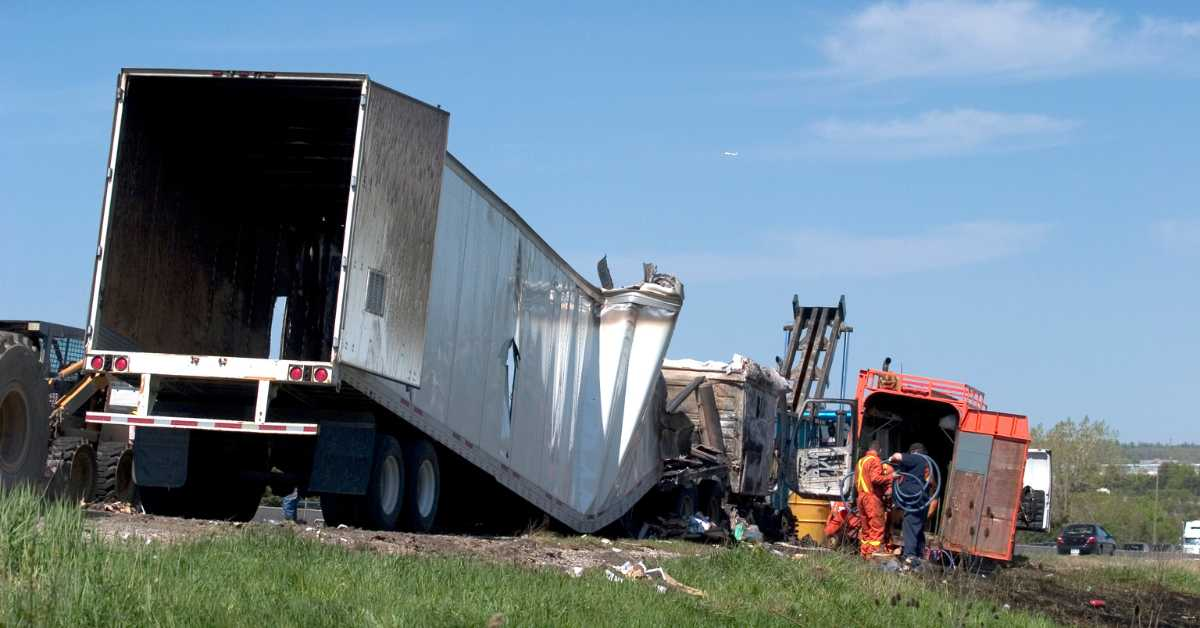
Surviving a collision with a commercial vehicle leaves you physically shattered and emotionally overwhelmed. You are suddenly thrust into a chaotic world of medical bills, aggressive insurance adjusters, and unanswered questions about how this tragedy happened. The sheer physics of these accidents makes them uniquely devastating. According to the Insurance Institute for Highway Safety (IIHS), large trucks often weigh 20 to 30 times as much as passenger vehicles.
This massive weight difference creates a terrifying reality on our highways known as “The Goliath Disparity.” In collisions between an 80,000-pound semi-truck and a standard family car, the occupants of the smaller vehicle take the brunt of the impact. The numbers prove this grim reality. The National Highway Traffic Safety Administration (NHTSA) reports that 70% of people killed in large-truck traffic crashes in 2023 were occupants of other vehicles.
Why the Driver Is Rarely the Only One to Blame
A common question survivors ask is whether they can sue the trucking company if the driver was the one who physically caused the crash. The short answer is yes. You are rarely limited to holding only the individual truck driver accountable.
The law recognizes a foundational legal doctrine known as respondeat superior, which translates to “let the master answer.” In personal injury law, this is called vicarious liability. It means an employer is legally bound to the actions of its employees while they are on the clock. If a truck driver runs a red light and causes a catastrophic accident while making a delivery, the trucking corporation that hired them shares the financial and legal responsibility for the damage.
Driver mistakes certainly happen. Federal data shows that driver error is the critical reason in 87% of large truck crashes. Yet, stopping the investigation at driver error lets the corporation off the hook.
Why did the driver make that error? Often, the root cause is systemic corporate failure. Intense job pressures, unrealistic delivery schedules, and severe fatigue force drivers to make dangerous choices. When a crash occurs, we must transition from examining the driver’s mistakes to uncovering the direct negligence of the corporation itself.
Holding the Trucking Company Directly Accountable
Investigating a commercial vehicle crash means finding out not just what happened, but why it happened at a corporate level. Trucking companies are massive entities focused on maximizing profits, sometimes at the expense of public safety.
Because these corporations operate on a national scale, they have deep pockets and aggressive defense teams. Holding them directly accountable requires looking at their internal practices. You need legal advocates with the specific resources to litigate across state lines and pull back the curtain on corporate operations.
Uncovering these patterns takes far more than reviewing a police report. It requires preserving critical evidence, analyzing company records, and identifying whether negligent hiring, poor maintenance, or safety violations contributed to the crash. That’s why working with a truck accident law firm that has the resources to investigate complex commercial carriers can make a meaningful difference when pursuing accountability against every responsible party.
Negligent Hiring and Entrustment
What exactly is negligent hiring? It occurs when a transportation company ignores critical red flags in a driver’s background check just to fill an empty seat. If a company hires a driver with a history of reckless driving, multiple speeding tickets, or revoked licenses, they are directly at fault when that driver inevitably causes a crash.
A related concept is negligent entrustment. This happens when a company hands the keys of an 80,000-pound machine to someone they know is unfit to drive. A glaring example is allowing a driver to operate a vehicle under the influence of drugs or alcohol, or failing to conduct mandatory drug screenings.
The Danger of Negligent Maintenance
Commercial trucks take a massive beating on the road. Because of this, the Federal Motor Carrier Safety Regulations (FMCSR) impose strict, mandatory inspection, repair, and maintenance standards. Trucking companies are legally required to keep detailed logs proving their fleets are roadworthy.
When massive systems fail on a heavy truck, the results are catastrophic. The Federal Motor Carrier Safety Administration (FMCSA) found that brake problems were coded as a factor in almost 30% of large truck crashes. When brakes fail because a company decided to save a few dollars on maintenance, the corporation is directly liable for the devastation that follows.
Uncovering Third-Party and Manufacturer Liability
Finding out who is at fault requires looking at the entire supply chain, not just the company whose logo is painted on the truck door. Multiple outside entities touch a commercial vehicle before it ever hits the highway.
If a truck crashes, outside contractors, independent mechanics, or parts manufacturers might share the blame. Uncovering total liability means exploring every single avenue of compensation to ensure your medical bills and long-term damages are fully covered.
| Party Involved | Potential Liability |
|---|---|
| Cargo Loader | Overloaded freight, unbalanced trailers, improper tie-downs causing cargo shifts. |
| Independent Mechanic | Faulty brake repairs, missed inspections, installing improper replacement parts. |
| Parts Manufacturer | Defective tire treads, failing hydraulic systems, faulty steering columns. |
Cargo Loaders and Rollover Crashes
If freight is improperly secured, unbalanced, or packed too high, it dramatically changes the truck’s center of gravity. When the driver takes a turn or applies the brakes, shifting cargo can cause the massive vehicle to jackknife or roll over completely.
In these situations, the third-party cargo loading company can be held separately liable for the damages. Your legal team will investigate loading manifests and warehouse records to prove that the crash started long before the truck ever left the shipping yard.
Defective Parts and Manufacturer Liability
Can a manufacturer be held liable if a truck part fails? Absolutely. Sometimes, a crash happens because a brand new piece of equipment was inherently flawed from the factory. Domestic and foreign parts manufacturers can be forced to pay for the damage their defective products cause.
Defective parts like faulty braking systems, weak trailer hitches, or blown tire treads create unavoidable disasters on the road. Even a perfectly trained driver cannot stop a truck if the manufacturer sold them a defective air brake system.
Historically, holding manufacturers accountable has led to massive safety improvements across the industry. For example, consumer advocacy and aggressive litigation once forced the National Highway Traffic Safety Administration (NHTSA) to recall 450,000 faulty Chinese-made truck tires that were prone to catastrophic tread separation. By pursuing manufacturer liability, survivors not only get the compensation they need but also force dangerous products off the market.
Stopping Corporate Cover-Ups
Corporate insurance adjusters will arrive at the scene of a commercial crash almost immediately. Their primary job is to minimize payouts, control the narrative, and hide systemic failures. They know that if the objective evidence disappears, your case relies solely on a “he said, she said” argument with the driver.
You cannot rely on subjective driver testimony. Building a winning case requires objective, forensic technology and 3D scene scanning to prove exactly what happened. The most critical step in this process is making sure the trucking company does not destroy the evidence before you can examine it.
Extracting Objective Truth from the “Black Box”
People often ask what a truck’s “Black Box” is and what specific data it holds. Modern commercial trucks are equipped with an Electronic Control Module (ECM), which functions as the vehicle’s brain.
The ECM records objective pre-crash data, completely bypassing the driver’s version of events. Even if a driver claims they were driving the speed limit and hit the brakes in time, the Black Box will tell the truth.
Conclusion
Fault in a commercial truck crash rarely begins and ends with the driver alone. While the person behind the wheel might have made the final error, the root cause of the tragedy usually lies hidden within a web of corporate negligence.
Uncovering the truth means exploring every layer of the trucking industry. Liability can easily extend to the trucking corporation for negligent hiring, third-party loaders for unbalanced cargo, independent maintenance providers for skipped inspections, and parts manufacturers for defective equipment. Navigating this web is complex and requires specialized knowledge.
This is why hiring a legal team with specific, deep expertise in highly technical Federal Motor Carrier Safety Regulations (FMCSR) is non-negotiable. Massive transportation corporations have teams of lawyers protecting their bottom line. You deserve an equally powerful team fighting for your future. By acting quickly to preserve evidence and demand the objective truth, survivors can force negligent corporations to answer for the devastation they cause.
